02 October 2013

HUNGER IN INDIA

Hunger in India: 'The real cause is lack of political will'
Damning Action Aid report warns nearly half the country's children are malnourished and calls on the west to deliver on its aid promises
Tribal villager Thakur Das demonstrates how children are branded in Mirgitand, India, to 'cure' them of hunger. The poker is glowing red hot in the flames of the burning wood. Suklal Hembrom holds a leaf against his stomach and warily eyes the older man sitting on the other side of the fire. Suddenly Thakur Das takes hold of the poker and lunges towards the boy's stomach.
Everyone in the village knows what should happen next. The child will scream loudly as the flesh begins to blister. Held down, he will writhe in agony. Again and again, the poker will jab at his belly. The more the child screams, the happier everyone will be, because the villagers of Mirgitand in India's Jharkhand state believe the only way they can "cure" the distended stomachs of their famished children is by branding them with pokers.

Das sees nothing wrong with the procedure. Nor does anyone in the village – most have scars of their own. Even though some children have died, the villagers continue because the alternative – providing enough nutritious food to sustain their children or paying for medical treatment – is simply not an option. In common with millions of others in the world's 11th largest economy, they face a daily battle to put even the most basic meal on the table.

A report out today warns that even in a fast-growing economy like India, failure to invest in agriculture and support small farms has left nearly half the country's children malnourished, with one fifth of the one billion plus population going hungry.

ActionAid, which published the report ahead of next week's summit in New York to discuss progress on the millennium development goals, sayshunger is costing the world's poorest nations £290bn a year – more than 10 times the estimated amount needed to meet the goal of halving global hunger by 2015.

India now has worse rates of malnutrition than sub-Saharan Africa: 43.5% of children under five are underweight and India ranks below Sudan and Zimbabwe in the Global Hunger Index. Even without last year's disastrous monsoon and the ensuing drought and crop failures, hunger was on the increase.

The government has promised a new food security bill to provide cheap food for the poor, but progress has been slow. The reality is that a country desperate to take its place at the world's top table is unwilling to commit to feeding its own population.

Last month the country's supreme court castigated the government for allowing 67,000 tonnes of badly stored grain to rot – enough to feed 190,000 people for a month – and ordered it to distribute 17.8m tonnes in imminent danger of rotting.
India's prime minister, Manmohan Singh, protested, saying the court had crossed the line into policy-making and warning that distributing free food to the estimated 37% of the population living below the poverty line destroyed any incentives for farmers to produce. The court stood firm. It was an order, not a suggestion, the judges said.

According to ActionAid, global hunger in 2009 was at the same level as in 1990. The charity urged developed countries to make good on £14bn pledge to fight hunger, announced at last year's G8 summit in Italy.
"On the eve of the most important development summit for five years, a billion people will be going to bed hungry," said Meredith Alexander, the charity's policy head. "Despite promises to the contrary, one-sixth of humanity doesn't get enough to eat. But we grow enough food to feed every man, woman and child on the planet. The real cause of hunger isn't lack of food, it is lack of political will."
The UN Food and Agricultural Organisation announced today that the number of hungry people worldwide has dropped by 98 million to 925 million in the past year. However, Oxfam warned the decline is largely down to luck, such as two years of favourable weather patterns, rather than action from world leaders.
Abandoned to its fate
Mirgitand lies in hills about 195km east of the state capital Ranchi, at the end of a stony, vertiginous track. It is part of India, but at the same time not part of it: abandoned to its fate by the state, in the hands of Maoist Naxalite guerillas who hold the security forces at bay with apparent ease.
Das squats next to the fire, poking it with a stick. The poker lies cooling on the ground. This time he did not make contact, warned in advance that the child must not be harmed for the demonstration, though he came worryingly close.
Instead, the villagers instruct the children to show their scars. Molilal Kisku lifts his shirt. He is five, with a large, distended belly. There are dark circles on the skin from where the poker was applied. There is not a child unscarred.
Manoranjan Mahta, 44, sits on a log, watching. He works for the post office, he says: he is an educated man. Yet he submitted his son, Hemanth, to the process.
"My son had a protruding belly. We went to many doctors, but they didn't cure it," he says. "In this village when a child has a big pot belly we put a piece of banana leaf on the skin and then we put burning charcoal or a burning rod on the leaf. If the child is writhing in pain, the notion is that the germs are dying."
But it was Hemanth who succumbed. The wound became infected and he died on 21 December 2007. He was seven years old.
Struggle for survival
India may be thriving economically but it is still dogged by poverty and hunger.
A recent Oxford University report found 410 million people were living in poverty in just eight Indian states – more than in the 26 countries of sub-Saharan Africa.
Last year's Global Hunger Index placed India in the "alarming" category, ranked 65 out of 84 countries, below even North Korea.
Across the country, hundreds of millions are malnourished. A study released in May warned that 66% of children under the age of six in Delhi's slums were malnourished. The report noted that the most vulnerable sections of society were not covered under government schemes which were supposed to support them.
In Jharkhand state, a study of 20 villages carried out last year recorded 13 deaths from starvation and 1,000 families suffering from chronic hunger syndrome. It is estimated that each year, nearly 50,000 children in the state die before their first birthday. It does not help that Jharkhand's doctors are among the most poorly paid in India, earning barely half what their contemporaries in Delhi might earn. This may explain why 2,200 of the 2,468 doctors recruited by the state five years ago have moved on. The state is said to need more than 800 primary health centres, although it has just 330.
The situation in the central Indian state of Madhya Pradesh is, if anything, worse than in Jharkhand. More than half a million children below the age of five have died in the past five years and 60% of its children are categorised as malnourished. The government estimates that 37% of the population subsist on less than the official poverty line of 327 rupees (£4.57) per month in rural areas and 570 rupees in urban areas. In May, television and newspaper pictures showed 100,000 tonnes of wheat rotting in the open in the state.
And in Ganne, in Uttar Pradesh, children have resorted to eating mud. When the reports began to surface, officials apparently sent some food and told the villagers to keep quiet.
1 In 8 Suffers From Chronic Hunger Globally, U.N. Report Says

Schoolgirls eat a free midday meal in Hyderabad, India, last month. India has offered such meals since the 1960s to persuade impoverished parents to send their children to school. A U.N. report released Tuesday finds modest progress in the worldwide fight against chronic hunger.
Originally published on Tue October 1, 2013 1:17 pm
Worldwide, roughly 1 in 8 people suffered from chronic hunger from 2011 to 2013, according to a new report from three U.N. food agencies.
They concluded that 842 million people didn't get enough food to lead healthy lives in that period, a slight drop from the 868 million in the previous report.
The modest change was attributed to several factors, from economic growth in developing countries to investments in agriculture. And in some countries, people have benefited from money sent home by migrant workers. But the gains were unevenly distributed, the report's authors say.
The State of Food Insecurity in the World report found that 15.7 million of the world's hungry live in developed countries; the remainder live in developing nations, where the challenge of poverty persists, particularly in rural areas.
"Sub-Saharan Africa has made only modest progress in recent years and remains the region with the highest prevalence of undernourishment," the Food and Agriculture Organization said, "with one in four people (24.8 percent) estimated to be hungry."
The report found that "more substantial reductions in both the number of hungry and prevalence of undernourishment have occurred in most countries of East Asia, Southeastern Asia, and in Latin America."
The report was published by the Food and Agriculture Organization, the International Fund for Agricultural Development and the World Food Program. Its authors said they found progress even in areas that are stricken by poverty.
"Policies aimed at enhancing agricultural productivity and increasing food availability, especially when smallholders are targeted, can achieve hunger reduction even where poverty is widespread," the heads of the three agencies said in a statement accompanying the report. "When they are combined with social protection and other measures that increase the incomes of poor families, they can have an even more positive effect and spur rural development, by creating vibrant markets and employment opportunities, resulting in equitable economic growth."
To see more, visit http://www.npr.org/.http://www.google-analytics.com/__utm.gif?utmac=UA-5828686-4&utmdt=1+In+8+Suffers+From+Chronic+Hunger+Globally%2C+U.N.+Report+Says&utme=8(APIKey)9(MDA4NjIwNTkwMDEzMjI4NDY0MjY4ZTBlNA004)


29 September 2013

How are new elements discovered?

Several experimental techniques have been used to make new chemical elements.
Some of these include
i)              heavy ion transfer reactions,
                 ii)      cold or hot fusion evaporation reactions,
iii)             neutron capture reactions,
                Iv)       light-ion charged particle induced reactions, and
                 V)        even nuclear explosions.
These techniques each have advantages and disadvantages making them suitable for studying nuclei in certain regions.

The types of nuclear reactions that have been successfully used to produce new elements in the last decade are cold fusion reactions and hot fusion reactions. 

Cold fusion reactions use beam and target nuclei that are closer to each other in mass in order to produce a compound nucleus (the complete fusion of one target nucleus with one beam nucleus) with generally lower excitation energy that typically requires evaporation of one or no neutrons. This generates fewer neutron-rich isotopes of an element that have higher survival probabilities with respect to fission, but have lower fusion probabilities. An example of this type of reaction is70Zn + 208Pb → 277112 + 1n with a cross-section of ~1 picobarn.


Because the 112 isotope ultimately decays by α emission to known nuclei [namely isotopes of elements 102 (No) and 104 (Rf)], identification of this element is straightforward. Hot fusion reactions use more asymmetric beam and target nuclei, produce a compound nucleus with generally higher excitation energy that typically requires evaporation of three to five neutrons, generate more neutron-rich isotopes of an element, have lower survival probabilities with respect to fission, but have higher fusion probabilities.
 An example of this type of reaction is 48Ca + 244Pu → 288114 + 4n with a cross-section of ~1 pb. Because of the neutron-richness of this isotope of element 114, it never subsequently decays to any known isotope, and thus its identification is more problematic. Cold fusion reactions have been successful in producing elements 104—112 and hot fusion reactions have recently provided evidence for elements 113—118.

New names for elements 114 and 116

New Names for Elements 114 and 116

Scientists of the Lawrence Livermore National Laboratory (LLNL)-Dubna collaboration proposed the names as Flerovium for element 114, with the symbol Fl, and Livermorium for element 116, with the symbol Lv, late last year.
The International Union of Pure and Applied Chemistry (IUPAC) officially approved new names for elements 114 and 116, the latest heavy elements to be added to the periodic table, on May 31, 2012. See IUPAC news ite

Flerovium (atomic symbol Fl) was chosen to honor Flerov Laboratory of Nuclear Reactions, where superheavy elements, including element 114, were synthesized. Georgiy N. Flerov (1913-1990) was a renowned physicist who discovered the spontaneous fission of uranium and was a pioneer in heavy-ion physics. He is the founder of the Joint Institute for Nuclear Research. In 1991, the laboratory was named after Flerov -- Flerov Laboratory of Nuclear Reactions (FLNR).

Livermorium (atomic symbol Lv) was chosen to honor Lawrence Livermore National Laboratory (LLNL) and the city of Livermore, Calif. A group of researchers from the Laboratory, along with scientists at the Flerov Laboratory of Nuclear Reactions, participated in the work carried out in Dubna on the synthesis of superheavy elements, including element 116. (Lawrencium -- Element 103 -- was already named for LLNL's founder E.O. Lawrence.)

The IUPAC states Livermorium was chosen because over the years scientists at Livermore have been involved in many areas of nuclear science: the investigation of fission properties of the heaviest elements, including the discovery of bimodal fission, and the study of prompt gamma-rays emitted from fission fragments following fission; the investigation of isomers and isomeric levels in many nuclei; and the investigation of the chemical properties of the heaviest elements.

"These names honor not only the individual contributions of scientists from these laboratories to the fields of nuclear science, heavy element research, and superheavy element research, but also the phenomenal cooperation and collaboration that has occurred between scientists in these two countries," said Bill Goldstein, associate director of LLNL's Physical and Life Sciences Directorate.
Scientists at LLNL have been involved in heavy element research since the Laboratory's inception in 1952 and have been collaborators in the discovery of six elements -- 113,114,115,116,117 and 118.
Livermore also has been at the forefront of investigations into other areas related to nuclear science such as cross-section measurements, nuclear theory, radiochemical diagnostics, separations chemistry including rapid automated aqueous separations, actinide chemistry, heavy-element target fabrication and nuclear forensics.

HOW THEY ARE CREATED

The creation of elements 116 and 114 involved smashing calcium ions (with 20 protons each) into a curium target (96 protons) to create element 116. Element 116 decayed almost immediately into element 114. The scientists also created element 114 separately by replacing curium with a plutonium target (94 protons).

The creation of elements 114 and 116 generate hope that the team is on its way to the "island of stability," an area of the periodic table in which new heavy elements would be stable or last long enough for applications to be found.

The official names will be published in the July issue of the IUPAC journal, Pure and Applied Chemistry.
The process of discovery and naming of an element is a long one. Experiments first glimpsed element 114 in 1998 and element 116 in 2001, with continuing experiments satisfying the discovery criteria in 2004 and 2006, and confirmatory experiments by other laboratories in 2007 – 2010.

The collaboration is led by Dr. Yuri Ts. Oganessian. The participants in these experiments include:

Dubna: Yu.Ts. Oganessian, V.K. Utyonkov, F.Sh. Abdullin, A.N. Polyakov, I.V. Shirokovsky, Yu.S. Tsyganov, R.N. Sagaidak, G.G. Gulbekian, S.L Bogomolov, B.N. Gikal, A.N. Mezentsev, V.G. Subbotin, A.M. Sukhov, A.A. Voinov, K. Subotic, G.K. Vostokin, M.G. Itkis, V.I. Zagrebaev, R.I. Il’kaev, S.P. Vesnovskii

LLNL: 
K.J. Moody, D.A. Shaughnessy, M.A. Stoyer, J.M. Kenneally, C.A. Gregorich, J.H. Landrum, R.W. Lougheed, J.B. Patin, N.J. Stoyer, J.F. Wild, and P.A. Wilk

24 September 2013

How to Favor an E2 Mechanism

       How to Favor an E2 Mechanism
1. Use a secondary or tertiary alkyl halide if possible.
Why: Because steric hindrance in the substrate will inhibit substitution.
2. When a synthesis must begin with a primary alkyl halide, use a bulky base.
Why: Because the steric bulk of the base will inhibit substitution.
3. Use a high concentration of a strong and nonpolarizable base such as an alkoxide.
Why: Because a weak and polarizable base would not drive the reaction toward a bimolecular reaction, thereby allowing unimolecular processes (such as SN1 or E1 reactions) to compete.
4. Sodium ethoxide in ethanol(EtONa/EtOH)and potassium tert-butoxide intertbutyl alcohol(t-BuOK/t-BuOH)are bases typically used to promote E2 reactions.
Why: Because they meet criterion 3 above. Note that in each case the alkoxide base is dissolved in its corresponding alcohol. (Potassium hydroxide dissolved in ethanol or tert-butyl alcohol is also sometimes used, in which case the active base includes both the alkoxide and hydroxide species present at equilibrium.)
5. Use elevated temperature because heat generally favors elimination over  substitution.

Why: Because elimination reactions are entropically favored over substitution reactions (because the products are greater in number than the reactants). Hence ∆S° in the Gibbs free-energy equation, ∆ G°=∆ H°   -  T  ∆S° is significant, and ∆S° will be increased by higher temperature since T is a coefficient, leading to a more negative (favorable) ∆G°.


28 July 2013

Table of Functional Group Priorities for Nomenclature


Here are some examples of applying the order of functional group priorities to solve nomenclature problems. The highest ranked functional group becomes the suffix – it’s highlighted in red.


25 June 2013

7 Factors that stabilize negative charge in organic chemistry

 It’s good – but not enough – to recognize partial charges and to figure out where they interact.
Since reactions involve processes that lead to the gain or loss of charges, understanding the factors that stabilize (or destabilize) charge have a tremendous impact on how likely a reaction is given to occur! Let’s talk about negative charge today.
Let’s talk about a concrete example. For instance if a reaction leads to the formation of a very unstable negative charge, it’s unlikely to occur. But if it leads to the loss of a very unstable negative charge, it’s considerably more likely.
For instance, that’s why one of these reactions of methane is likely and the other is unlikely. That’s going to be explored in more detail in future posts.
So what factors lead to the stabilization of negative charge? Two main things.
  1. negative charge is stabilized by adjacent positive charge (opposite charges attract!)
  2. negative charge tends to be less stable when it’s concentrated and more stable when it’s dispersed.
Think about that as you look at this list of seven factors that stabilize negative charge.
 1. High charge densities are unstable  
This one’s fairly straightforward to understand. High charge densities are unstable. So as we move from water to OH(-) to O(2-), we are getting progressively more unstable here.
2. Electronegativity
Electronegativity is a rough measure how effectively  the positively charged nucleus of an atom can “pull” electrons toward it. (Opposite charges attract.) Electronegativity increases as we go across the periodic table. So if you compare the anions going from C , N, O to F across the periodic table, the stability of the negative charge will increase.
3. Polarizability
Down the periodic table, it’s a little more helpful to think  “dispersal of charge is good!” rather than   “opposite charges attract”.  Compare fluorine and iodine. The size of the fluorine ion (radius: 119 pm) is much smaller than iodine (radius: 206 pm). However, they both have a charge of negative 1.
Imagine two balls, each weighing one pound. But one is made of iron, and the other is made of rubber. Which ball is going to be smaller? The iron ball (smaller and harder) is like fluorine, and the rubber ball (larger and squishier) is like iodine. And a certain “squishiness” helps to stabilize charge, since it isn’t as concentrated over a small volume. That’s a way of expressing the greater polarisability of iodine.
4. Resonance
Along the same lines, a negative charge that is adjacent to one or more Pi bonds can disperse its negative charge over multiple atoms. We describe this phenomenon as “resonance”. So in the example below, the negatively charged alkane on the left is much less stable than the adjacent negatively charged species, where the negative charge can be dispersed over multiple carbons through resonance.
5. Electron withdrawing groups. 
This one falls more into the auspices of “opposite charges attract”. A negative charge that is adjacent to an atom with electron withdrawing groups on it will be stabilized greater than one that is not. In the extreme case of CCl3(-), the resulting ion is many orders of magnitude more stable than H3C(-) itself. (This is the basis of the haloform reaction).
6. Orbitals. 
s orbitals are closer to the nucleus than p orbitals are. So electrons that are in s orbitals will be closer to the nucleus than electrons in p orbitals – and therefore, lower energy (“opposite charges attract”). For this reason, electrons that are in sp orbitals are lower energy than sp2, which is lower energy than sp3, since they have greater s character (33% for sp2) than sp3 (25%). This makes the anions more stable.
7. Aromaticity.
This is a special case, covered in detail in organic chemistry 2. Certain molecules possess a special stability – called aromaticity – that is enormously stabilizing, kind of like qualifying for an huge tax break from the government. Certain negatively charged molecules – such as the cyclopentadienyl anion, pictured below – are aromatic, and therefore possess much greater stability than they would have otherwise.
So how the heck do we keep track of all of this?
Seven factors?!!! So how do we know which is most important?  That’s a great question! These trends can interact with each other in unpredictable ways, and it’s hard to judge which is most important.
Thankfully, there’s a concept you’ve probably already met for figuring out the stability of these species, which can be readily measured. It’s called basicity. These  factors determine how stable a base will be!
 The basicity of a species tells you about how stable its lone pair of electrons are.  
How do we find a good measure of basicity? Simple. It’s in the Pka table , a collection of measurements that’s been compared to the table of hand strengths in poker.
Bottom line:
  • Two factors to watch out for: opposite charges attract, and dispersal of charge.
  • unstable anions will tend to be at the intial tails of arrows (form bonds).
  • stable anions will tend to be at the final heads of arrows (likely to be leaving groups)

Common Mistakes: How not to draw resonance curved arrows

There are at least three common categories of mistakes regarding resonance structures:
  • Unbalanced equations
  • Moving atoms around
  • Incorrect drawing of resonance arrows
Let’s first talk about unbalanced resonance equations, where something (either an atom or electrons) has been added or subtracted. Remember that in drawing resonance forms we’re only allowed to move electrons, and nothing more. That means that the two resonance forms can neither differ in the number of their electrons nor can they differ in the number of atoms.
Moving atoms around is a second category of common mistake. Although the two structures shown below have the same number of atoms and electrons, they are not resonance forms because we have broken single bonds (as opposed to π bonds) and thus moved the location of one or several atoms. The easiest way to screw this up is to move hydrogens. While these molecules are related, they are actually pairs of constitutional isomers, not resonance structures.
One way to avoid making these types of mistakes is to try to interconvert the structures using curved  arrowsThere are only three legal arroe pushing moves for drawing resonance structures. Double check to make sure you aren’t breaking the rules.
The last – and by far the most common class of mistake in drawing resonance structures is to screw up the curved arrows. There is a seemingly infinite number of different ways to do this. They fall into a number of sub-categories.
First, there’s arrow-pushing moves that are wrong and cannot be redeemed. Examples A-D each depict different ways of breaking the octet rule. In A, B, and C the resonance form that would result from these arrows would have five bonds to carbon. Example D would have five bonds to nitrogen. Inconceivable! 
Examples E and F  are wrong for a different reason: remember that the curved arrow depicts the movement of a pair of electrons. In example E, the “tail” of the leftmost arrow is shown at a positive charge – a big no-no, since there isn’t a lone pair of electrons here. Likewise for F, where the positively charged nitrogen also lacks an electron pair.
Then there’s arrow pushing “moves” that are also illegal, but can be made legal through drawing an additional arrow. See if you can draw an arrow to make it work (answers at the bottom).
Then there’s the sloppy mistakes, where these arrow pushing forms are missing something important. I guess you could say this entire post is devoted to sloppy mistakes but these examples are particularly egregious because they are just one tiny little detail away from being correct. In these two cases, there is neither a lone pair of electrons (or a formal negative charge) at the tail of one of the electron-pushing arrows, which make them incorrect. Neglecting to draw the formal charge of an atom is another common sloppy mistake (albeit not unique to resonance). Note that when I say sloppy I’m not making a moral judgement here. I’m just saying it makes for imprecise and ambiguous chemical structures, which are not useful.
Finally, there are resonance structures which are not illegal, per se, but  won’t make a significant contribution to the resonance hybrid.
In both examples we have very electronegative elements (oxygen and nitrogen) with less than a full octet. Recall that electronegativity is a rough measure of the ability of an atom to stabilize negative charge? Well, the converse is true – that is, the greater the electronegativity, the more positive charge will be destabilized on that atom (clarification: by “positive charge” here I am specifically referring to having less than a full octet of electrons (like a carbocation), not the common situation where O or N with a full octet bears a formal charge of +1.)
Avoiding all of these mistakes requires careful attention to detail, bordering on paranoia. The number of atoms and electrons on the left side of the resonance arrow should balance the number of atoms and electrons on the right side of the resonance arrow. Furthermore, the changes in bonding (and charge)  of the molecule on the left side of the arrow should beaccurately mapped by the appropriate curved arrow(s).
If it sounds like I’m making a case for organic chemistry being a lot like accounting, you’re right!  In the final analysis, organic chemistry equations are not unlike accounting transactions. The two sides need to balance.

P.S. Here’s the answers for the example above:
7-answers

The 8 Types of Arrows In Organic Chemistry, Explained

To my knowledge there are 8 different types of arrows you meet in organic chemistry. Here’s a little guide to them.
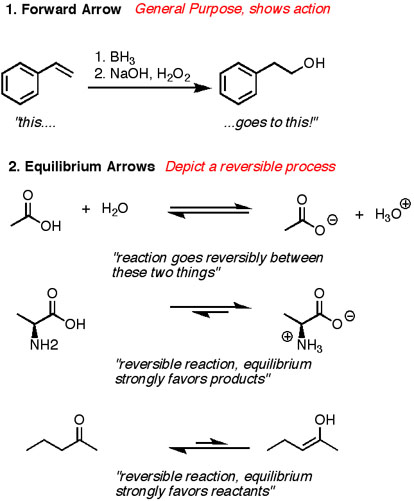
1. The forward arrow, otherwise known as the “reaction arrow”. The purpose of this arrow is to show action. Now, “BH3, then NaOH/H2O2″ might not exactly seem like  your idea of “action”, but put yourself in the alkene’s position – it’s double bond is being ripped asunder in order to form new bonds to boron and hydrogen, and then with the addition of H2O2,  the bond to boron is replaced with one to oxygen. That’s a pretty eventful day in the life of an alkene.
There isn’t any hard and fast rule about what is supposed to go above or below the arrow, although reagents tend to go above and solvents tend to go below.  You’ll often see a sequence of reactions placed over the arrow and numbered “1) , 2), 3), etc. These represent individual steps that could often be shown with individual arrows of their own, but they are placed in series here over the arrow to save space.
2. The Equilibrium arrow. This shows a reaction that is reversible, usually in the context where the reversibility is being highlighted (such as in a reaction mechanism). To further highlight the position of an equilibrium, you may also occasionally see one of the arrows being longer than the other, showing that the equilibrium favors the starting materials or products.
3. The Resonance arrow. Not to be confused with the equilibrium arrow, this double-headed arrow shows two (or more) species that are resonance structures of each other. That is to saythey differ in the arrangements of their electrons and nothing else. Although it’s a separate discussion, it’s important to note that the molecule *does not* shuffle back and forth between these forms, but instead the “true picture” of the molecule is a combination or hybrid of these structures.

4. The Dashed Arrow. This is often used to show a speculative or theoretical transformation, where conditions might have yet to be discovered. Alternatively in a test situation it’s a way of visually depicting the question, “How would you do this?”
5. The Curved Arrow (double headed).  The curved arrow formalism is such an important tool that entire books have been devoted to it (for instance, I highly recommend checking out “Arrow Pushing in Organic Chemistry” by Daniel Levy). The point of the curved, double-headed arrow is to show the movement of an electron pair. They start at the tail and end up at the head. Hugely important for following how mechanisms work. Deserving of a series of posts in itself.
6. The Curved Arrow (single headed). The single-headed (or “single-barbed”) arrow depicts the movement of a single electron. Useful in discussions of radical chemistry mechanisms in particular.  Identical in all other respects to the double-headed arrow.
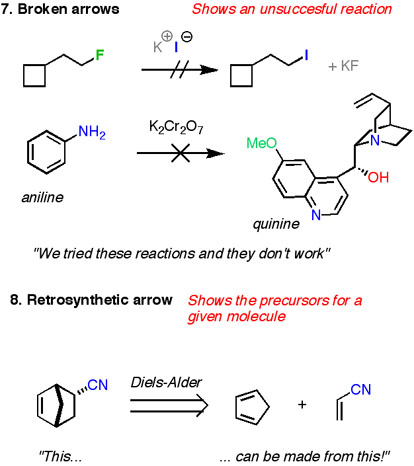
7. The Broken Arrow. This is used to show reactions that don’t work: fluorine is a bad leaving group in nucleophilic substitutions, for example. And quinine can definitely not be synthesized from the oxidation of aniline.
8. The Retrosynthesis Arrow. The open arrow here doesn’t actually show a “reaction”, per se, but instead more of a mental exercise. The retrosynthetic arrow is meant to depict the process of breaking down a complex molecule to simpler starting materials. This is useful as a planning device to highlight a key strategy used for building a molecule.